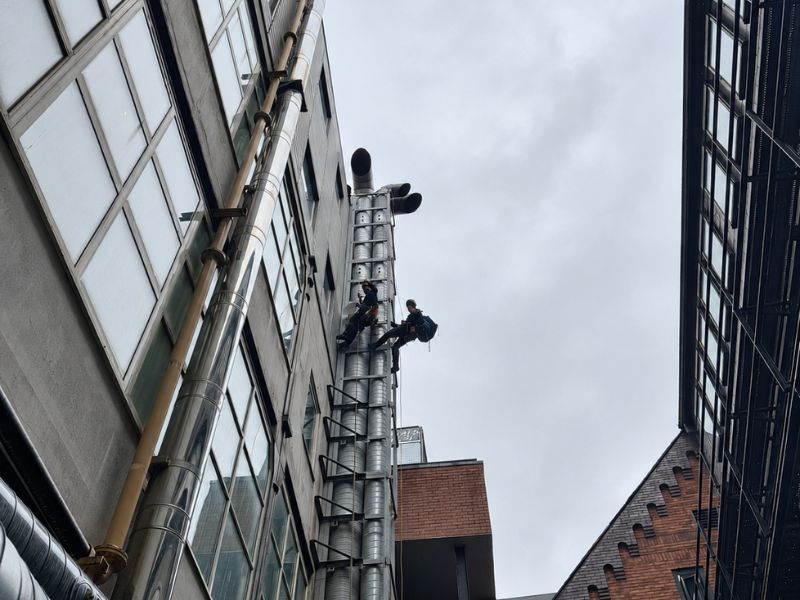
Rope access helps trained technicians reach kitchen extract ductwork in vertical risers, narrow shafts, roof areas, lightwells and other high-level spaces. Technicians can use this access method to inspect the system, install access panels and carry out kitchen extract cleaning in areas that conventional equipment may not reach.
Every project requires a site-specific assessment and safe system of work. If technicians still cannot reach part of the system, they must record it as inaccessible and exclude it from the completed cleaning certificate.
Why inaccessible kitchen extract ductwork creates a serious concern
A commercial kitchen extract system extends far beyond the visible canopy. Depending on the building, ductwork may pass through ceilings, service voids, several floors or an external vertical riser before it reaches the extractor fan and discharge point.
Cooking releases grease-laden vapours into the complete system. Although filters capture some contamination, grease can still collect on duct surfaces, bends, access points and fan components.
A thorough kitchen extract cleaning programme must therefore consider the complete extraction route—not only the sections that technicians can easily reach from the kitchen.
Some contractors repeatedly clean the canopy while leaving high-level ductwork or vertical risers untouched. Hidden grease can then continue to accumulate, increase fire risk, restrict airflow and leave facilities teams without an accurate record of the system’s condition.
Where do kitchen extract cleaning access problems occur?
Technicians often encounter access difficulties when ductwork passes through:
Vertical risers extending through several storeys
Narrow service shafts and restricted voids
External elevations and lightwells
High-level plant areas
Roof spaces with limited conventional access
Areas above extensions or adjoining buildings
Locations without enough space for scaffolding
Sections that ladders or mobile access equipment cannot reach safely
Hotels, restaurants, hospitals, universities, residential developments and older city-centre buildings often contain these types of extraction routes.
How does rope access support kitchen extract cleaning?
Rope Access 24 Seven allows appropriately qualified technicians to reach high-level and restricted areas without always relying on extensive scaffolding or large mobile access equipment.
Technicians can use rope access during several stages of a kitchen extract cleaning project.
Inspecting the ductwork
Technicians can follow the external ductwork route, inspect existing access panels and determine whether the current arrangement provides adequate internal access.
The inspection may also identify damaged duct sections, contaminated fan components, unsuitable access points or areas that previous contractors omitted.
Installing access panels
Technicians need suitable access to clean internal duct surfaces thoroughly. When panels are missing, incorrectly positioned or too small, the team may need to install new access panels.
Rope access can help technicians reach the relevant part of a high-level riser and install panels in practical positions. Before starting, the team must consider the duct construction, fire rating and surrounding site conditions.
Cleaning high-level ductwork
Once the team has established safe and suitable access, technicians can remove grease deposits from the internal surfaces.
They will select a cleaning method based on the system design, contamination level, duct dimensions and available working space. They must also contain the removed grease and cleaning residues to protect the building and surrounding external areas.
Reaching extractor fans
Contractors often find extractor fans on roofs or at the top of vertical risers. Where the site assessment supports rope access, technicians can reach the fan housing, inspect its condition and complete the required cleaning.
Collecting photographic evidence
Technicians can photograph the ductwork before and after kitchen extract cleaning.
These images help facilities teams understand which sections the team accessed, what contamination they found and whether the system requires further access work or remedial action.
What should you do when kitchen extract ductwork is inaccessible?
1 Review previous cleaning reports
Check whether previous contractors recorded any sections as inaccessible, not inspected or outside the agreed scope. Look for vague descriptions or repeated photographs that do not identify specific areas.
2 Trace the complete extraction route
Establish where the ductwork travels after it leaves the canopy. Include internal horizontal sections, vertical risers, external ductwork, the extractor fan and the final discharge point.
3 Arrange a site access assessment
Ask a specialist contractor to assess the building, extraction system and surrounding area. The contractor can then recommend rope access, scaffolding, a mobile elevated work platform or another suitable method.
4 Identify the required access panels
Plan access panels in positions that allow technicians to reach the internal surfaces, changes in direction, fan connections and other obstructions.
5 Plan the kitchen extract cleaning work
The contractor should prepare a safe system of work covering access, cleaning methods, containment, waste handling and protection of the surrounding area.
6 Record every accessible section
The post-clean report should identify each section that technicians inspected and cleaned. Before-and-after photographs should clearly correspond with specific system locations.
7 Document any remaining limitations
The report must identify every section the team could not access. The contractor must not describe or certify these areas as cleaned.
Why choose rope access instead of scaffolding?
Rope access can provide several practical benefits during difficult kitchen extract cleaning projects.
It often requires less ground-level space than scaffolding.
It can reduce disruption around entrances, delivery areas and pedestrian routes.
It can give technicians faster access to isolated sections of ductwork.
It can work well for external risers within narrow lightwells.
It can reduce the need for large equipment on restricted city-centre sites.
It can support inspection, access-panel installation and cleaning during one planned project.
However, rope access will not suit every building. A competent site assessment must determine the safest and most practical method.
Can rope access help with multi-storey kitchen extract risers?
Yes. Rope access can provide an effective solution when kitchen extract ductwork rises several storeys along an external elevation, enclosed courtyard or lightwell.
Technicians can descend alongside the riser, inspect its condition and reach strategically positioned access panels. This approach can extend kitchen extract cleaning beyond the sections that teams can reach from the kitchen or roof.
Internal risers may require additional planning, particularly when they sit inside enclosed building shafts. Rope access cannot replace suitable duct openings, sufficient working space or safe internal access.
What should a kitchen extract cleaning report include?
A professional report should provide a clear and traceable record of the work.
It should identify the extraction system and cleaning date.
It should describe every section that technicians accessed and cleaned.
It should include relevant before-and-after photographs.
It should identify the extractor fan and discharge point where inspected.
It should record every inaccessible section.
It should highlight missing or inadequate access panels.
It should explain any recommended remedial work.
The dated certificate provides a formal record of the completed work and must match the actual scope. If technicians could not access a section, the certificate must not present that area as clean or complete.
Kitchen extract cleaning and BSEHV11
Operatives trained to the relevant BSEHV11 National Occupational Standard should carry out kitchen extract cleaning.
This training helps technicians understand how to inspect, access and clean commercial kitchen extract systems correctly. Any technician who uses rope access must also hold the appropriate qualifications for that access method.
Cater Clean 24 Seven works alongside IRATA-qualified technicians when a project requires specialist high-level access. This approach combines kitchen extract cleaning expertise with the skills required to work safely in challenging locations.
Common questions
Does rope access remove the need for access panels?
No. Rope access helps technicians reach the outside of high-level ductwork, but they still need suitable panels to clean the internal surfaces. Technicians can also use rope access to install new panels where the system and site conditions allow.
Can technicians complete kitchen extract cleaning entirely from the canopy?
Only when the system design genuinely allows them to access every required section from that position. Complex and multi-storey systems rarely provide this level of access. The contractor should inspect the complete route before agreeing the cleaning scope.
Does rope access always cost less than scaffolding?
Not necessarily. The cost depends on the building, system design, project duration and safety requirements. However, rope access may offer a more efficient option where scaffolding would prove extensive or difficult to position.
Can technicians use rope access inside a building?
In some locations, yes. Technicians may use internal rope access in atriums, shafts, risers and large voids. The project will require suitable anchors, rescue planning and a site-specific risk assessment.
What happens if technicians still cannot reach part of the ductwork?
The team must identify the inaccessible section in the report. Cater Clean may recommend additional access panels, opening a service shaft or using an alternative access method.
Will kitchen extract cleaning disrupt kitchen operations?
Cater Clean 24 Seven can schedule work outside normal operating hours to minimise disruption. The required timeframe will depend on the system size, access arrangements and contamination level.
Can Cater Clean arrange both duct cleaning and rope access?
Yes. Cater Clean 24 Seven can coordinate kitchen extract cleaning with specialist rope access support through the wider 24 Seven Group. This gives facilities teams one coordinated solution for inspection, access-panel installation, cleaning and reporting.
When to call Cater Clean 24 Seven
Contact Cater Clean 24 Seven if your kitchen extract system includes vertical risers, roof-level fans, external ductwork or sections that previous contractors have recorded as inaccessible.
Our team can assess the extraction route, identify access limitations and develop a practical kitchen extract cleaning programme. When a project requires specialist high-level access, we can coordinate IRATA-qualified technicians to support the work.
We never present inaccessible areas as complete. Our reports clearly distinguish between the sections our teams successfully accessed and any areas that require further work.
Cater Clean 24 Seven provides specialist kitchen ventilation cleaning and duct cleaning services for restaurants, hotels, takeaways and commercial catering facilities.